When Will Russia Stop Fighting? WEI Forecast: Summer 2027
The treasury need not suddenly run dry for the rising cost of war to force a decision. WEI identifies next summer as its forecast window for the war’s end.
WEI forecasts that the Russia–Ukraine war will end in summer 2027. Here, ‘end’ means the cessation of sustained large-scale combat and a ceasefire arrangement that holds. It does not presume a signed peace treaty or Russia’s formal surrender. This is WEI’s forecast: fiscal data establish the direction of pressure, but cannot calculate a war’s end date.
A widening deficit means more money must be found
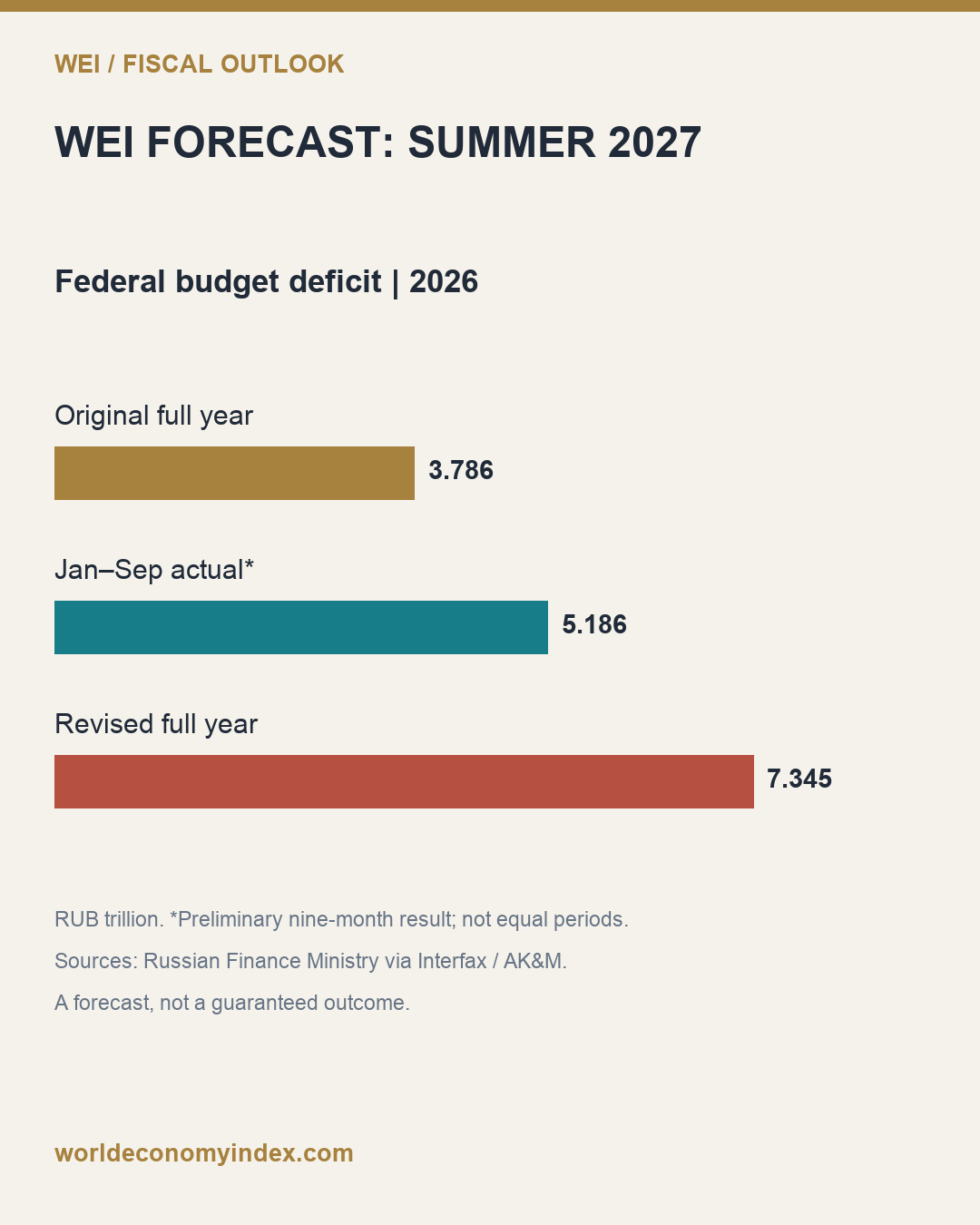
Preliminary Russian Finance Ministry figures put the federal deficit for January–September 2026 at RUB 5.186 trillion. The full-year estimate was raised from the original RUB 3.786 trillion to RUB 7.345 trillion—an increase of about 94%. The planned balance between revenue and expenditure now requires substantially more financing. [1]
Revenue is diverging. In the first nine months, oil and gas receipts fell 17.2% year on year, while non-oil-and-gas revenue grew 18.8%. Total revenue still rose 10% to RUB 29.639 trillion, but expenditure increased 14.5% to RUB 34.825 trillion. Russia has not stopped collecting taxes or lost all its income; spending is rising faster. [1]
WEI’s concern is how this gap develops. If next year’s revenue growth continues to depend on higher taxes while war spending remains difficult to cut, the government must repeatedly choose between raising funds, sustaining businesses and protecting other expenditure. War can retain priority, but the economy bears the cost.
Assets on the books are not the same as ready cash
As of 1 October 2026, Russia’s National Wealth Fund held RUB 12.985 trillion in total assets, including RUB 3.8 trillion in liquid assets, equivalent to about US$45 billion. The liquid portion was approximately 29.3% of the total. This remains an important buffer, but the whole fund cannot be treated as immediately spendable cash. [2]
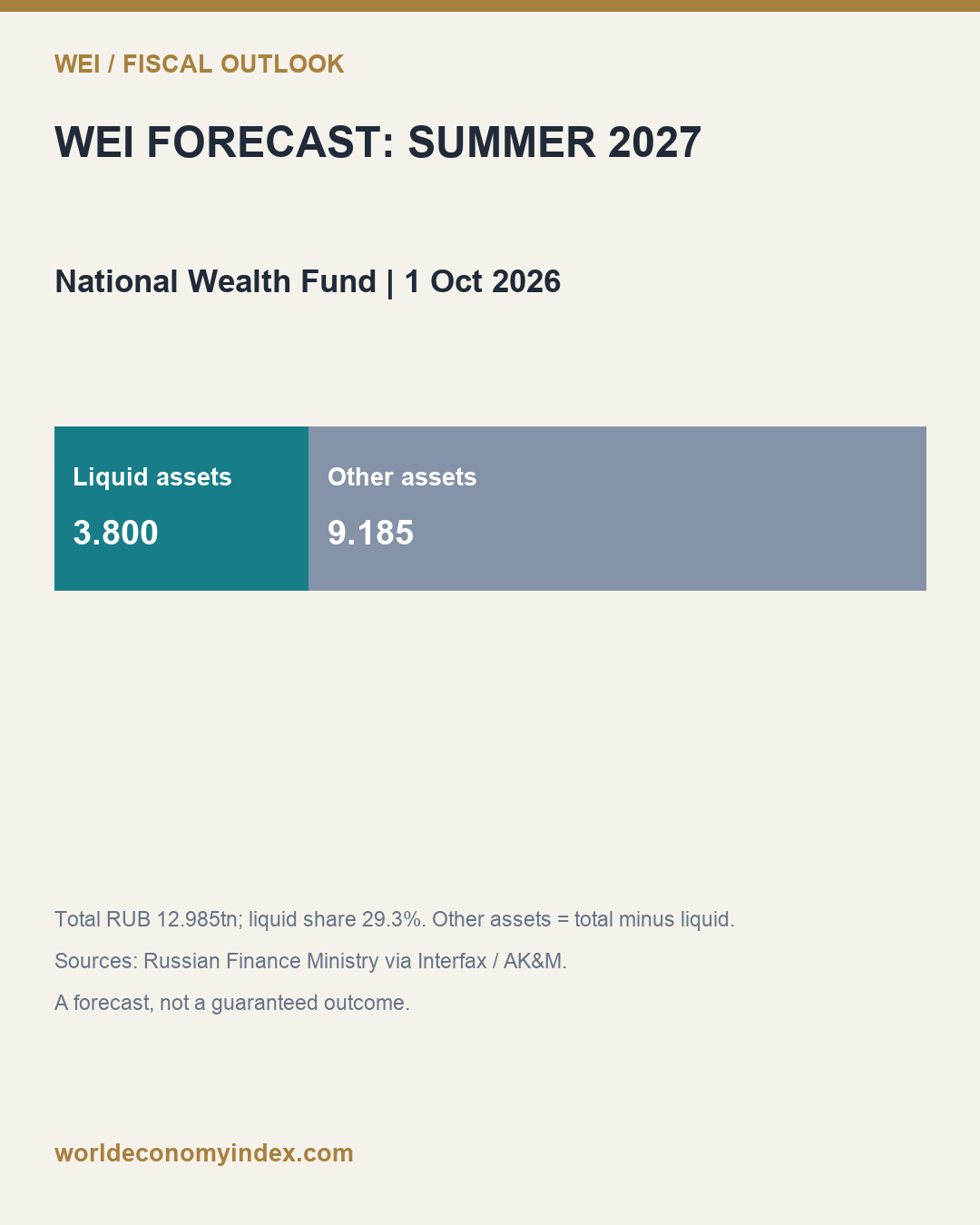
Dividing RUB 3.8 trillion by the monthly average of the RUB 7.345 trillion estimated annual deficit gives approximately 6.2 months. This only compares scales: if the fund alone covered that deficit, the buffer would be limited. It is not a depletion forecast, because borrowing and other channels can finance deficits, and receipts and payments are seasonal. WEI does not use ‘6.2 months’ as a formula for a ceasefire next summer.
Why next summer?
WEI’s reasoning is that Russia must incur further costs to sustain fighting between now and summer 2027. If energy revenue does not improve materially, fiscal buffers keep shrinking and financing depends increasingly on domestic funds, the economic and political price of continuing the war could rise.
Taxes, borrowing and cuts elsewhere can prolong the war. The turning point need not be the inability to pay another rouble: decision-makers may instead conclude that paying for further battlefield gains is less attractive than accepting a ceasefire. WEI expects that choice to help bring the war to an end in summer 2027.
Why summer rather than another part of 2027? Public fiscal documents provide no evidence that fixes a particular month. Summer is WEI’s chosen forecast window, incorporating judgment about the transmission of fiscal pressure and the pace of political negotiations. It must not be presented as a forecast by the Finance Ministry or a research institute.
The evidence against this forecast belongs in the article too
Russia retains financing and adjustment options. SIPRI’s examination of the new draft budget says tax increases and other measures are expected to lift revenue. The draft assumes a deficit of 2.2% of GDP in 2027, down from 3.2% in 2026. Russia’s own budget scenario therefore does not envisage imminent fiscal collapse. [3]
SIPRI also estimates that total military spending in 2026 could reach approximately RUB 17 trillion. Continued high spending demonstrates the priority given to war—and shows why ‘war is expensive’ alone does not prove it will end soon. Future budgets can be revised; they prove neither inevitable continuation nor a ceasefire next year. [3]
If energy earnings recover markedly, financing remains smooth or decision-makers accept further costs to the civilian economy, the war could exceed WEI’s deadline. If fiscal strain coincides with military setbacks, a ceasefire could arrive earlier.
Three signals that can test the argument
First, whether the National Wealth Fund’s liquid assets keep falling. Second, whether government bond issuance requires higher costs to attract sufficient funding. Third, whether reliable evidence shows arrears in defence-industry payments, military compensation or local government finances. The first two measure financing pressure; the third bears more directly on the war machine. Unverified rumours of arrears must not be written as established facts.
If large-scale fighting continues through summer 2027, WEI’s timing forecast will not have materialized. Continued fiscal strain would not make that original timing prediction correct.
WEI forecasts that the Russia–Ukraine war will end in summer 2027. Russia may not call its exit ‘surrender’; it may seek to portray a ceasefire as the completion of its objectives. Whether this forecast holds depends on fiscal costs combining with battlefield and negotiating conditions to change decisions.
WEI opinion | 21 October 2026. Data: published January–September 2026 fiscal execution and fund balances at 1 October. Summer 2027 is WEI’s judgment, not a statistically calibrated or official forecast.
[1] https://www.interfax.com/newsroom/top-stories/119478/
[2] https://www.akm.ru/eng/news/the-volume-of-nwf-as-of-october-1-amounted-to-12-985-trillion-rubles-/