WEI · MSTR
Strategy’s Double Risk: WEI’s Position Is Sell
WEI’s judgment: Sell Strategy. A bullish view of Bitcoin is not a reason to take on two layers of risk.
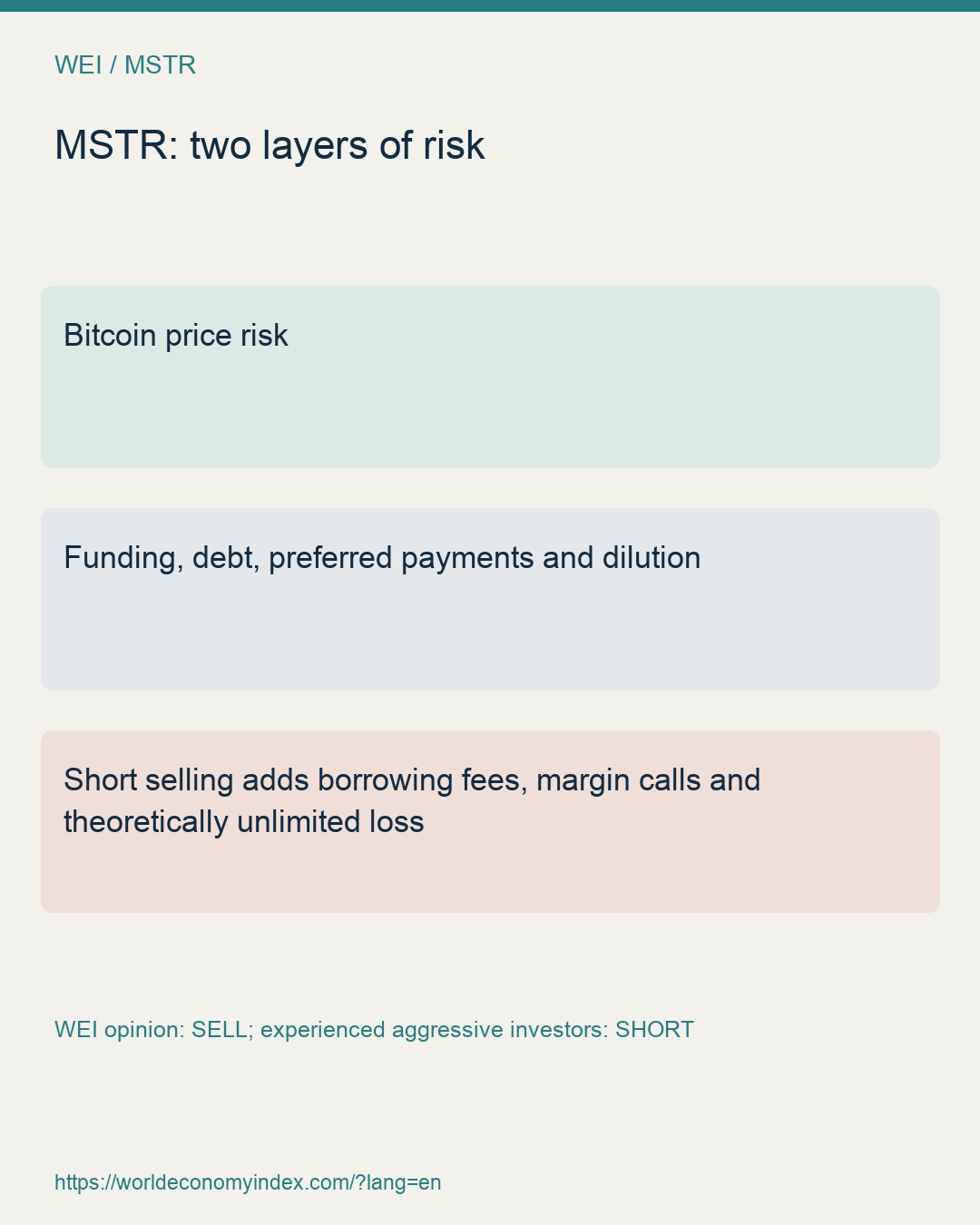
MicroStrategy is now called Strategy, with the ticker MSTR. It originally developed enterprise software and later invested substantial funds in Bitcoin. This article’s position is clear: Sell MSTR. Shareholders face not only Bitcoin’s price movements, but also corporate funding, debt, preferred-stock payments and equity-dilution risks. Stacking those two layers of risk cannot be resolved simply by saying “I am bullish on Bitcoin over the long term.”
How did it get here?
2020: It began buying Bitcoin. It made Bitcoin its primary reserve asset and subsequently issued shares and borrowed money to buy more. [1]
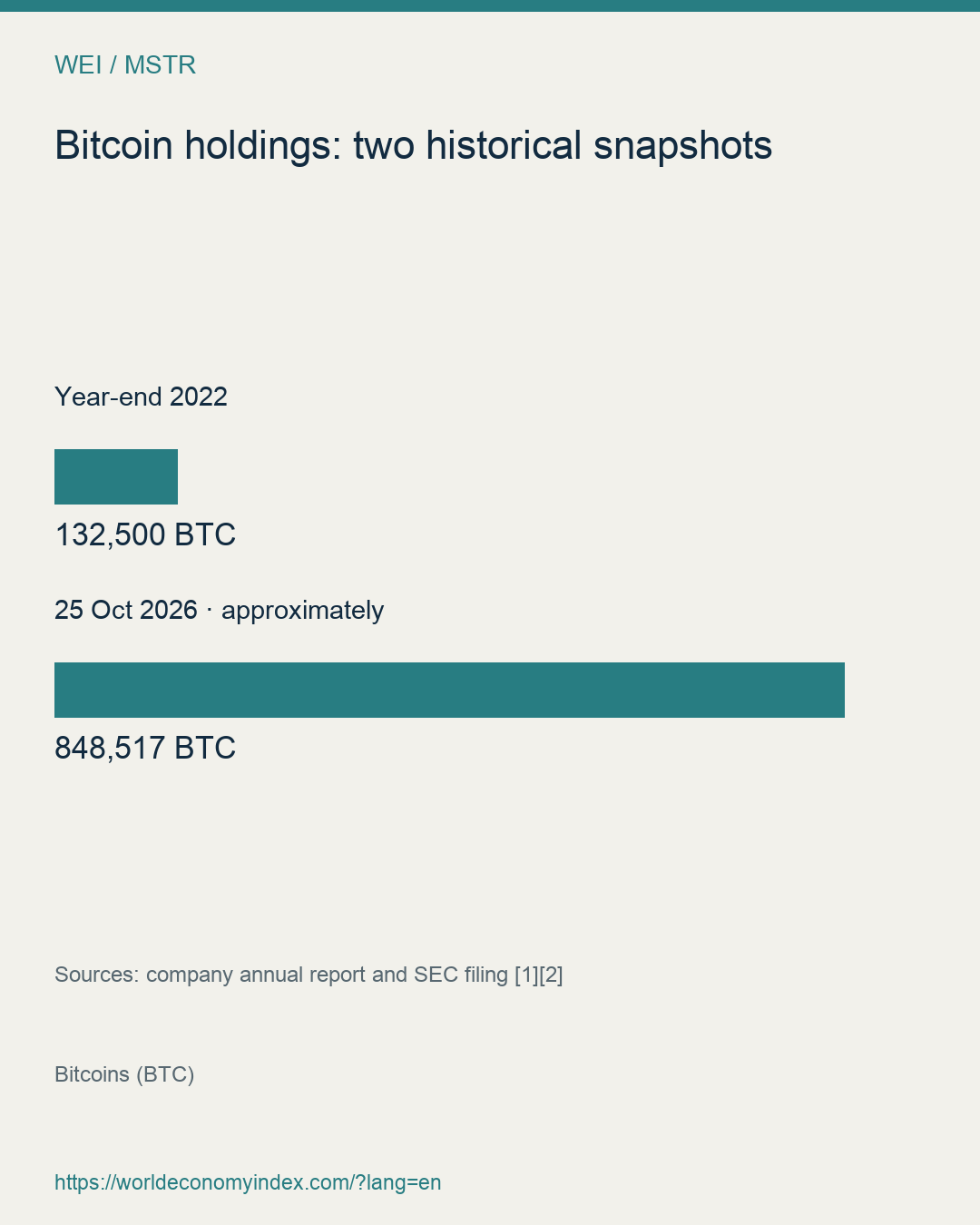
2022: It kept holding through a downturn. Bitcoin fell sharply that year, yet the company continued buying and ended the year with 132,500 coins. It also sold a small portion during the year; it has not literally never sold Bitcoin. [1]
2026: More coins, and payments to arrange. As of 25 October, it held approximately 850,000 bitcoins. This year it sold about US$432 million of Bitcoin to fund some dividends and repurchase preferred shares. Preferred shares are a class whose dividends rank ahead of common shares. [2][3]
This history shows a continuing willingness to hold Bitcoin for the long term, alongside changes in how it operates when it needs funds.
Your Own God, Not Strategy’s God
Your faith is in Bitcoin, not in Strategy.
If you are buying because you believe in Bitcoin’s future, ask yourself why you end up buying a company’s stock. The additional debt, dividends, financing arrangements and management decisions cannot all be brushed aside by saying “It is bullish on Bitcoin too.”
Bitcoin is your judgment; Strategy is its business. When it raises money, which securities it issues and whether it sells coins are decisions driven first by the company’s funding needs. They do not necessarily match your entry cost, holding period or return objective. Its commitment to Bitcoin is not a promise to make you money.
A bullish view of Bitcoin can therefore be a starting point for researching MSTR, but it cannot replace the case for buying MSTR. You must separately answer: At this share price, what do you receive in exchange for taking additional corporate risk? If the answer is only “I trust it,” you are buying confidence in the company as well as Bitcoin’s prospects.
Do not entrust your judgment to a company’s slogan. Assess Bitcoin’s value yourself, and do a separate calculation for Strategy’s stock. Your own god is not Strategy’s god.
The first risk: Bitcoin falls, putting holdings under pressure
Strategy owns a large amount of Bitcoin, so changes in its price affect the value of those holdings. Buying MSTR does not let you bypass Bitcoin’s volatility. Even if you believe in Bitcoin’s value years from now, you may first have to live through a deep and prolonged decline.
The second risk: the company has bills, and shareholders pay a price
The company cannot simply wait for Bitcoin to rise. Debt, interest and preferred-stock payments all require funding arrangements. The sources cited in the draft show a US dollar reserve and previous Bitcoin sales to fund payments; some bonds also give investors the right to demand repurchase in 2027. There is a buffer, but funding pressure cannot be ignored. [2][3][4]
Issuing new shares raises money but may dilute existing shareholders’ ownership. Selling coins can pay bills, but those bitcoins no longer remain with the company. Obtaining funding and remaining in business are not the same as delivering attractive returns to common shareholders. [5]
The two risks may amplify one another: If Bitcoin falls while funding becomes harder to obtain, the company may have fewer choices for meeting payments. Decisions made to raise cash may in turn impose more costs on common shareholders. This is a scenario to guard against, not a claim that the company has already suffered a funding breakdown.
The next year: the company may continue, while we still choose to sell the stock
I still lean toward Strategy continuing to hold substantial Bitcoin over the next year, raising money, retaining cash or selling some coins as needed. But that does not change this article’s judgment on the stock: Sell. The company’s continued commitment to Bitcoin does not oblige shareholders to keep bearing its financing structure.
Selling MSTR does not require first concluding that Bitcoin will collapse, nor waiting until the company encounters trouble. If Bitcoin recovers and funding goes smoothly, MSTR can certainly rebound, and sellers may miss that upside. WEI nevertheless chooses to sell because we do not want to take on a company’s funding arrangements and shareholder-dilution risk merely to express a bullish view of Bitcoin.
WEI’s position: Sell Strategy. Your faith is in Bitcoin, not in Strategy; conviction in Bitcoin should not become a reason to defend MSTR’s double risk.
The more aggressive position: Short Strategy
WEI’s further judgment is that aggressive investors who understand short selling and can bear the associated losses should short Strategy. Selling exits the two layers of risk; short selling actively bets that those risks will be reflected in its share price.
The short thesis rests on the same two sets of considerations: If Bitcoin continues falling while the company’s financing conditions deteriorate and payment pressure increases, MSTR common shares could face further stress. This is the scenario judgment behind the short view, not an assertion that the stock must fall. Selling and shorting must not be treated as equally risky actions.
Short selling requires borrowed shares and may involve continuing borrowing fees. If the stock rises, additional margin may be required, and insufficient funds may result in forced liquidation. A sharp rise and concentrated short-covering can also produce a short squeeze. Losses from directly shorting stock are theoretically unlimited. Even if the eventual direction proves correct, a rebound and holding costs may force an earlier exit. [6][7]
The article’s position is therefore: Sell MSTR; for aggressive investors with short-selling experience and the capacity to bear the risk, WEI further advocates shorting it. This is a trading judgment that separately entails costs and adverse price moves, not a profit automatically attached to a bearish opinion.
Your own god is not Strategy’s god. Keep your independent judgment about Bitcoin, and sell off blind trust in Strategy’s shares.